CONTACT US NOW TO RECEIVE A QUICK QUOTE, SAMPLE SUPPORT, AND ENGINEERING SERVICE GUARANTEE.








Aluminum Clip-In Ceilings for Commercial Interiors: Durable Modern Ceiling Solutions
Modern commercial interiors need ceiling systems that are visually clean, durable, and easy to maintain. Aluminum clip-in ceilings are a popular suspended ceiling solution for offices, shopping malls, airports, hospitals, hotels, and public buildings because they combine a concealed grid structure with reliable long-term performance.
Unlike gypsum or mineral fiber ceilings, aluminum clip-in ceiling panels offer better moisture resistance, corrosion protection, and easier maintenance access. The hidden suspension system creates a smooth, seamless appearance while allowing individual panels to be removed for inspection of lighting, HVAC, fire sprinklers, and electrical systems.
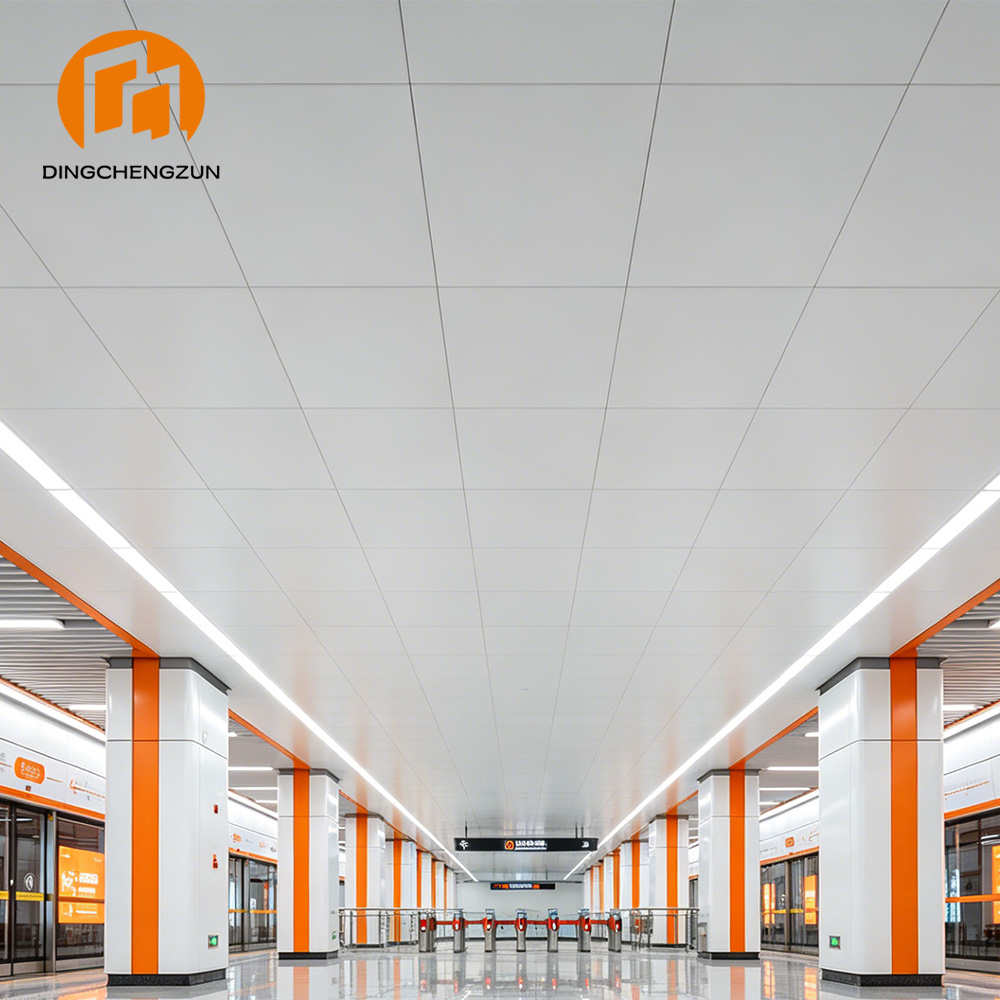
Aluminum False Ceiling Panels for Metro Station Interiors
Designed for metro stations and transportation hubs, these aluminum false ceiling panels provide excellent durability, fire resistance, easy maintenance, and a clean architectural appearance for large public interior spaces.
View Product / Get QuoteFor high-traffic commercial spaces, this makes aluminum clip-in ceilings a practical choice for both design and engineering requirements. With customizable sizes, perforation patterns, colors, and surface finishes, they can meet different architectural styles and project specifications.
As a professional aluminum ceiling manufacturer, DCZ Building provides customized clip-in ceiling solutions for contractors, architects, distributors, and commercial project developers worldwide.

What Is an Aluminum Clip-In Ceiling System?
2.1 Concealed Suspension Structure
An aluminum clip-in ceiling system is a suspended metal ceiling solution that uses a concealed grid structure to hide the supporting framework after installation. This creates a clean, seamless, and modern ceiling surface, making it suitable for offices, airports, shopping malls, hospitals, hotels, and other high-traffic facilities.
Each aluminum panel is securely clipped into the suspension system, helping maintain ceiling stability and panel alignment. Compared with exposed grid ceiling systems, clip-in ceilings provide a more refined architectural appearance and better ceiling uniformity, especially in premium commercial and public spaces.
Another key advantage is convenient maintenance access. Individual panels can be removed independently without damaging surrounding panels, allowing technicians to inspect lighting, HVAC ducts, fire sprinklers, and electrical wiring above the ceiling.
2.2 Common Panel Sizes & Specifications
Aluminum clip-in ceiling panels are available in different sizes and specifications to meet various project requirements.
Common panel sizes include:
- 300 × 300 mm
- 600 × 600 mm
- 600 × 1200 mm
Smaller panels are often used in corridors, hospitals, and service areas where frequent maintenance access is required. Larger panels are commonly selected for airports, shopping malls, and open commercial spaces to reduce visible joints and improve installation efficiency.
Panel thickness usually ranges from 0.5 mm to 1.0 mm. Thicker aluminum panels are recommended for large ceiling areas or projects that require higher structural stability, better flatness, and long-term durability.
Available surface finishes include:
- powder coating
- PVDF coating
- wood grain finish
- custom RAL colors
For offices, conference rooms, transportation hubs, and public buildings, perforated acoustic clip-in panels with sound-absorbing backing can also be used to improve indoor acoustic comfort.
Why Aluminum Clip-In Ceilings Are Ideal for Commercial Projects
3.1 Clean & Modern Architectural Appearance
Aluminum clip-in ceilings use a concealed suspension system that creates a smooth and seamless ceiling surface. Compared with exposed grid ceilings, this design delivers a cleaner architectural appearance and better ceiling uniformity for modern commercial interiors.
Their minimalist style integrates easily with lighting, ventilation, and other building systems, making them widely used in:
- office buildings
- shopping malls
- hotel lobbies
- airports
- public service facilities
For large commercial spaces, concealed ceiling systems also help improve the overall visual continuity of the interior environment.
3.2 Excellent Moisture & Corrosion Resistance
Unlike gypsum or mineral fiber ceilings, aluminum clip-in ceiling systems offer excellent resistance to moisture, corrosion, and deformation. This makes them suitable for humid regions, coastal cities, underground transportation hubs, and healthcare environments where long-term durability is essential.
High-quality powder coating and PVDF surface finishes further improve weather resistance and help maintain a stable appearance over years of use.
3.3 Easy Maintenance & Access
Convenient maintenance access is one of the main advantages of aluminum clip-in ceilings. Individual panels can be removed independently without affecting surrounding panels, allowing quick access to:
- HVAC systems
- lighting equipment
- fire sprinkler systems
- electrical wiring
This design helps reduce maintenance time and operating costs in large commercial buildings such as airports, shopping centers, and office complexes.
3.4 Fire Resistance & Hygienic Performance
Aluminum is a non-combustible material with reliable fire-resistant performance, making clip-in ceiling systems suitable for public buildings and high-traffic facilities.
Perforated aluminum ceiling panels with antibacterial coatings are commonly used in:
- hospitals
- laboratories
- healthcare facilities
- clean rooms
The smooth metal surface is easy to clean and supports hygienic interior standards.
3.5 Acoustic Performance for Commercial Interiors
Perforated aluminum clip-in ceilings combined with acoustic backing materials can improve indoor sound absorption and reduce echo in large interior spaces.
This is especially beneficial for:
- conference rooms
- airports
- commercial offices
- educational facilities
Acoustic ceiling systems help create a quieter and more comfortable indoor environment while maintaining a modern architectural appearance.
Clip-In Ceiling vs Traditional Ceiling Systems
When selecting ceiling materials for commercial and public projects, architects and contractors often compare aluminum clip-in ceilings with gypsum and mineral fiber ceiling systems. While traditional ceilings may have lower initial costs, aluminum clip-in ceiling systems usually provide better long-term durability, maintenance efficiency, and architectural performance.
| Feature | Aluminum Clip-In Ceiling | Gypsum Ceiling | Mineral Fiber Ceiling |
|---|---|---|---|
| Moisture Resistance | Excellent | Moderate | Moderate |
| Maintenance Access | Easy | Difficult | Moderate |
| Lifespan | 15–20 Years | 5–10 Years | 8–12 Years |
| Fire Resistance | Excellent | Good | Good |
| Recyclability | High | Low | Moderate |
| Modern Appearance | Excellent | Moderate | Moderate |
Compared with gypsum ceilings, aluminum clip-in ceiling systems are less likely to deform in humid environments and provide easier access to HVAC systems, lighting, and electrical wiring. This is especially important in airports, hospitals, shopping malls, and office facilities where regular ceiling maintenance is required.
Mineral fiber ceilings may offer basic acoustic performance, but they can absorb moisture over time and are more vulnerable to damage in high-humidity environments. Aluminum ceiling systems provide better dimensional stability, longer service life, and a cleaner architectural appearance for modern interior applications.
Although aluminum clip-in ceilings may have a higher initial material cost, they often help reduce long-term repair, replacement, and maintenance expenses in large commercial projects.
For projects that prioritize durability, maintenance efficiency, and modern ceiling design, aluminum clip-in ceilings are considered a reliable long-term solution.
5. Commercial Applications of Aluminum Clip-In Ceilings
5.1 Office Buildings
Aluminum clip-in ceilings are widely used in modern office projects because they create clean and organized interior environments while supporting efficient integration with lighting, air conditioning, and fire protection systems.
In open offices, meeting rooms, and reception areas, concealed ceiling systems help maintain a modern architectural appearance while allowing convenient access for future inspection of electrical and HVAC systems.
5.2 Shopping Malls & Retail Spaces
Shopping malls and retail stores require ceiling systems that can handle high daily visitor traffic and long operating hours. Aluminum clip-in ceilings provide a consistent architectural appearance while improving maintenance efficiency for lighting replacement and ventilation servicing.
Large ceiling panels are often selected for retail projects to reduce visible joints and create more visually open commercial spaces.
5.3 Hospitals & Healthcare Facilities
Hospitals and healthcare environments require ceiling systems that are hygienic, moisture-resistant, and easy to clean. Aluminum clip-in ceilings are commonly used in:
- waiting areas
- hospital corridors
- laboratories
- operating support areas
Perforated acoustic panels with antibacterial coatings can help improve indoor acoustic comfort while supporting hygienic interior standards in medical facilities.
In humid healthcare environments, aluminum ceiling systems also provide better resistance to mold and surface deformation than traditional gypsum ceilings.
5.4 Airports & Transportation Hubs
Airports, subway stations, and transportation terminals often use aluminum clip-in ceiling systems because of their long service life, fire resistance, and operational maintenance efficiency.
In large transportation projects where lighting and ventilation systems require regular inspection, removable ceiling panels help reduce maintenance interruptions and improve servicing efficiency in high-traffic public areas.
Their clean and uniform appearance also matches the architectural requirements of modern terminal buildings.
5.5 Educational & Public Buildings
Schools, libraries, museums, exhibition halls, and government facilities frequently use aluminum clip-in ceilings because of their durability and stable long-term performance.
For public buildings with continuous daily use, aluminum ceiling systems provide reliable maintenance accessibility, easy cleaning, and modern interior aesthetics suitable for both functional and architectural applications.
Engineering & Installation Considerations
6.1 Suspension System Stability
Proper suspension system design is essential for the long-term stability and safety of aluminum clip-in ceiling systems, especially in large commercial and public projects. A well-planned suspension structure helps maintain ceiling flatness, panel alignment, and structural reliability after installation.
Several engineering factors can affect ceiling performance, including:
- hanging rod spacing
- panel weight
- ceiling span dimensions
- seismic requirements
- HVAC coordination
In airports, shopping malls, and transportation facilities, suspension layouts often need adjustment to avoid conflicts with ventilation ducts, cable trays, and fire sprinkler systems. Detailed suspension planning can help reduce installation errors and improve overall project coordination.
6.2 Lighting & HVAC Integration
Modern commercial ceilings must integrate efficiently with building service systems. Aluminum clip-in ceiling systems are commonly coordinated with:
- LED lighting systems
- air diffusers
- sprinkler systems
- smoke detectors
- inspection access panels
Early coordination between ceiling modules, lighting layouts, and HVAC systems can help reduce visible ceiling gaps, alignment issues, and on-site construction conflicts. Proper planning also improves servicing accessibility for future equipment inspection and maintenance.
For large commercial interiors, integrated ceiling layouts help maintain both engineering efficiency and architectural consistency.
6.3 Common Installation Challenges
Large-scale ceiling installations may face several on-site construction challenges, including:
- panel alignment issues
- uneven ceiling leveling
- conflicts with MEP systems
- insufficient maintenance access planning
In complex commercial projects, inaccurate suspension positioning can affect ceiling uniformity and installation quality. Professional shop drawings, ceiling layout planning, and engineering coordination help improve installation accuracy and reduce project delays during construction.
For transportation hubs, hospitals, and large retail developments, proper installation planning is especially important for maintaining long-term ceiling performance and maintenance efficiency.
Customization Options
Different architectural projects often require ceiling systems with specific design, acoustic, and engineering requirements. DCZ Building provides project-specific aluminum clip-in ceiling solutions based on interior layouts, building functions, and architectural styles.
Available customization options include:
- tailored panel dimensions
- perforation patterns
- acoustic backing materials
- powder coating and PVDF finishes
- wood grain surface treatments
- RAL color matching
- integrated lighting and access panel solutions
For offices, transportation hubs, conference halls, and public facilities, perforated acoustic clip-in panels can improve sound absorption while maintaining a clean and modern ceiling appearance. Different perforation designs also help architects achieve specific visual and acoustic effects for large interior spaces.
In irregular ceiling layouts or large commercial areas, tailored panel dimensions can help reduce visible joints, improve installation consistency, and minimize material waste during construction. Ceiling systems can also be coordinated with lighting layouts, HVAC equipment, and inspection access requirements to improve overall project integration.
DCZ Building provides OEM and ODM manufacturing support for distributors, contractors, architects, and project developers worldwide. From ceiling design optimization to customized production and project coordination, the company offers flexible aluminum ceiling solutions for various architectural applications.
Real Commercial Project Applications
8.1 Shopping Mall Ceiling Project
In a large shopping mall renovation project, customized aluminum clip-in ceiling panels were installed to create a clean and continuous ceiling appearance across retail corridors and public circulation areas. The ceiling system was coordinated with integrated lighting, air diffusers, and fire sprinkler layouts to maintain a modern commercial interior design.
To improve ceiling consistency in wide open spaces, large-format ceiling panels were selected to reduce visible joints and simplify installation coordination during construction. The removable ceiling structure also provided convenient servicing access for future lighting replacement and HVAC maintenance during long-term retail operations.
8.2 Airport Ceiling Project
For a transportation terminal project, large-format aluminum clip-in ceiling systems were selected because of their fire resistance, structural stability, and maintenance accessibility in intensive-use public environments.
During installation, the suspension layout was adjusted to coordinate with ventilation ducts, cable trays, and safety systems above the ceiling. This helped improve construction coordination and reduce on-site installation conflicts in large passenger circulation areas.
The completed ceiling system provided a clean terminal appearance while allowing easier future inspection and servicing of lighting and mechanical systems.
8.3 Healthcare Facility Ceiling Project
In a healthcare facility project, perforated acoustic aluminum clip-in ceiling panels were installed in waiting areas, hospital corridors, and medical support spaces to improve indoor acoustic comfort and maintain hygienic interior conditions.
Compared with traditional gypsum ceilings, the aluminum ceiling system provided better moisture resistance and easier cleaning performance for humid healthcare environments. Acoustic backing materials also helped reduce indoor echo and improve comfort in continuously used public medical areas.
To support fire safety and maintenance requirements, removable access panels were integrated into the ceiling system for convenient inspection of lighting, ventilation, and medical service equipment.
FAQ
Can aluminum clip-in ceilings be customized?
Yes. Aluminum clip-in ceiling systems can be customized based on project requirements, including panel dimensions, perforation patterns, surface finishes, and RAL color options. Customized ceiling layouts can also be coordinated with lighting systems, HVAC equipment, and inspection access requirements for different architectural applications.
Are clip-in ceilings suitable for humid environments?
Yes. Aluminum clip-in ceilings provide excellent moisture resistance and corrosion protection, making them suitable for humid regions, coastal areas, healthcare facilities, and underground transportation environments where long-term ceiling stability is important.
Compared with traditional gypsum ceilings, aluminum panels are less likely to deform, absorb moisture, or develop surface damage over time.
Can lighting and HVAC systems be integrated?
Yes. Aluminum clip-in ceiling systems are designed to integrate efficiently with:
- LED lighting fixtures
- air diffusers
- sprinkler systems
- smoke detectors
- inspection access panels
Early engineering coordination helps improve installation consistency and reduce on-site construction conflicts in commercial projects.
Are acoustic perforated panels available?
Yes. Perforated aluminum clip-in ceiling panels with acoustic backing materials are widely used in offices, conference rooms, airports, hospitals, and educational facilities to improve indoor sound absorption and reduce echo in large interior spaces.
Different perforation patterns can also support both acoustic performance and architectural design requirements.
How long do aluminum clip-in ceilings last?
With proper installation and maintenance, aluminum clip-in ceiling systems can typically last 15–20 years or longer in commercial and public building applications.
High-quality powder coating and PVDF finishes also help maintain long-term surface durability, color stability, and corrosion resistance in demanding environments.


