СВЯЖИТЕСЬ С НАМИ ПРЯМО СЕЙЧАС, ЧТОБЫ ПОЛУЧИТЬ БЫСТРУЮ СМЕТУ, ПОДДЕРЖКУ ОБРАЗЦОВ И ГАРАНТИЮ ИНЖЕНЕРНОГО ОБСЛУЖИВАНИЯ.








Дизайн интерьера больницы с акустическими металлическими потолками
Modern hospital interior design has evolved far beyond basic medical functionality. Today’s healthcare facilities are designed to create quieter, safer, and more comfortable healing environments that support patient recovery, staff efficiency, and overall healthcare experiences. As patient-centered healthcare design continues to grow, acoustic performance has become an essential consideration in modern hospital architecture.
One of the most common challenges in healthcare facilities is excessive noise. In large hospitals, sounds from rolling carts, nurse stations, medical equipment alarms, HVAC airflow systems, crowded waiting areas, and public corridors can significantly increase sound reverberation throughout the building. These noise issues may negatively affect patient sleep quality, speech privacy, stress reduction, and communication efficiency between healthcare professionals.
For this reason, hospital acoustic ceiling systems are increasingly used in modern healthcare interior design projects. Acoustic metal ceilings provide an effective solution by combining sound absorption performance with hygienic surfaces, fire safety, durability, and modern architectural aesthetics.
Compared with traditional gypsum or mineral fiber ceilings, perforated acoustic metal ceilings offer better long-term performance in demanding healthcare environments. Their smooth aluminum surfaces are easy to clean and disinfect, making them suitable for high-traffic medical spaces where hygiene and infection control are critical. In addition, perforated aluminum ceiling panels with acoustic backing materials can achieve excellent sound absorption performance, helping reduce echo and improve acoustic comfort in patient rooms, consultation areas, hospital corridors, and waiting spaces.
Modern healthcare ceiling solutions also support seamless integration with lighting systems, air diffusers, fire sprinklers, and maintenance access requirements. With customizable finishes, wood-look coatings, and contemporary ceiling layouts, acoustic metal ceilings help architects create calm, professional, and visually welcoming healthcare interiors.
Today, acoustic metal ceilings are widely applied in hospital lobbies, patient recovery rooms, operating areas, diagnostic centers, laboratories, and healthcare public spaces as part of advanced hospital interior design strategies focused on healing environments, sustainability, and long-term building performance.
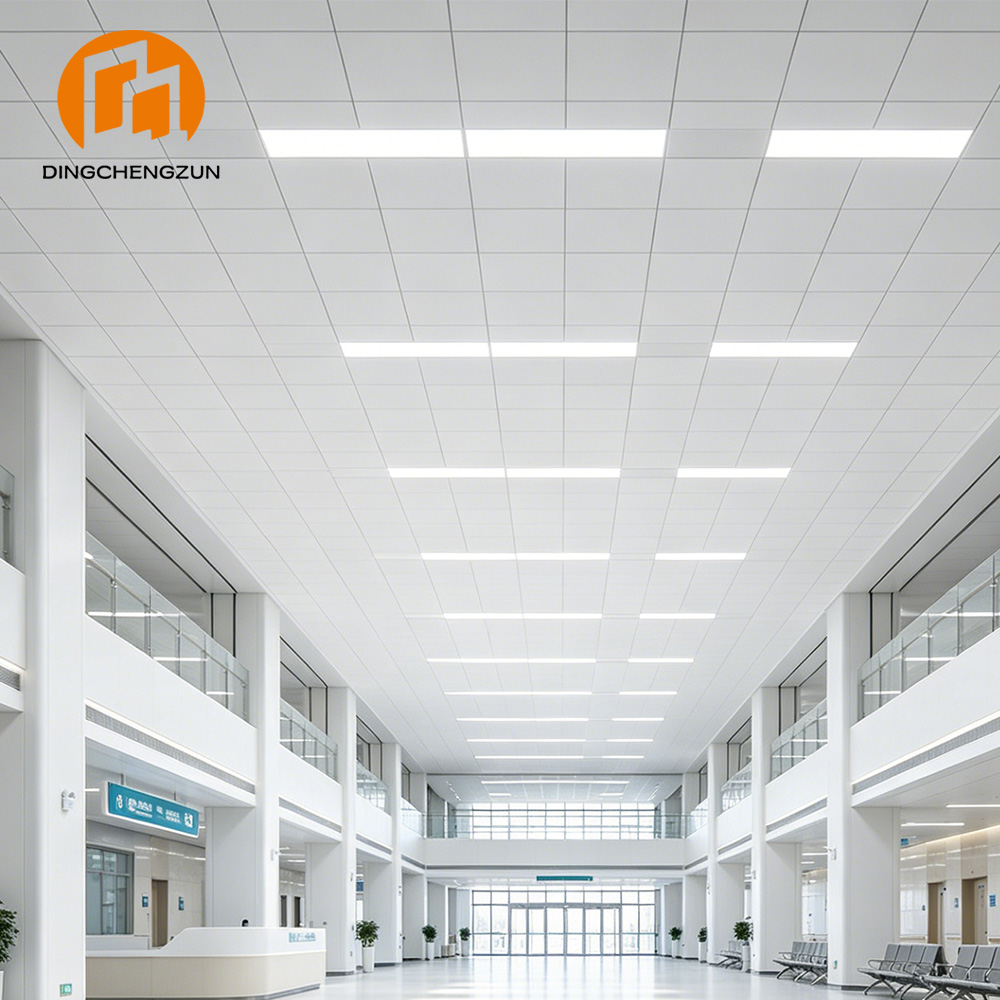
Алюминиевые потолочные панели с порошковым покрытием для больничных коридоров
Designed for healthcare interiors, these powder coated aluminum ceiling panels provide a clean appearance, corrosion resistance, easy maintenance, and long-term durability for hospital corridors, clinic walkways, and medical public spaces.
Посмотреть продукт / Получить предложениеWhy Acoustic Design Matters in Hospitals
Acoustic design has become an essential component of modern hospital interior design. Unlike ordinary commercial buildings, hospitals operate continuously throughout the day and night, with constant movement of people, medical equipment, ventilation systems, and emergency activities. In healthcare environments where patient recovery, concentration, and communication are critical, controlling indoor noise levels is no longer optional — it is a key part of creating effective healing environments.
In recent years, patient-centered healthcare architecture and evidence-based hospital design have placed greater emphasis on healthcare acoustics. Architects and healthcare planners are increasingly focusing on how sound affects patient comfort, staff efficiency, speech privacy, and overall healthcare experiences. As a result, acoustic ceiling systems for hospitals are now widely integrated into healthcare interior planning to improve both functionality and environmental quality.
Perforated acoustic metal ceilings are particularly suitable for modern healthcare facilities because they combine sound absorption performance with hygienic surfaces, fire resistance, durability, and easy maintenance. These systems help reduce sound reverberation in high-traffic medical environments while supporting the strict operational requirements of hospitals and healthcare infrastructure projects.
2.1 Noise Challenges in Healthcare Facilities
Hospitals contain multiple sources of continuous background noise that can easily spread through corridors, patient rooms, waiting areas, and public spaces. Common healthcare noise sources include:
- Medical monitoring alarms and emergency notification systems
- HVAC airflow and mechanical ventilation equipment
- Rolling carts, hospital beds, and trolley movement
- Staff conversations at nurse stations
- Elevator operations and corridor traffic
- Crowded reception and waiting areas
- Diagnostic and treatment equipment
In intensive care units (ICU), emergency departments, and recovery areas, noise levels often remain active throughout both daytime and nighttime operations. Hard interior surfaces such as concrete, glass, and traditional gypsum ceilings can increase sound reflection and reverberation, allowing noise to travel further across healthcare spaces.
Poor acoustic control may create stressful environments for patients and reduce operational efficiency for medical staff. This is why healthcare architects increasingly specify hospital acoustic ceiling systems that improve sound absorption and reduce echo within healthcare interiors.
Perforated aluminum acoustic ceilings with acoustic fleece backing materials can significantly improve indoor acoustic performance by controlling reverberation and balancing sound distribution in large healthcare environments.
2.2 Impact of Sound on Patient Recovery
Creating quieter healthcare environments is closely connected to patient well-being and recovery quality. Excessive noise in hospitals may negatively affect sleep, increase stress levels, and reduce overall patient comfort during treatment and recovery periods.
In patient recovery rooms, consultation spaces, and inpatient wards, continuous background noise from equipment alarms, corridor movement, and public activity can interrupt rest and create mental fatigue for patients and visitors. Maintaining speech privacy is also particularly important in consultation rooms and healthcare offices where confidential medical information is discussed.
Modern healthcare design increasingly focuses on healing environments that support emotional comfort as well as medical treatment. Acoustic metal ceiling systems help absorb unwanted sound, reduce reverberation time, and improve acoustic comfort throughout healthcare facilities.
In many hospital interior projects, perforated acoustic metal ceilings are used to create calmer and more controlled environments in patient rooms, waiting areas, diagnostic centers, and healthcare public spaces. These systems contribute to improved patient experiences while supporting modern healthcare acoustic standards.
2.3 Acoustic Comfort for Medical Staff
Effective acoustic control is equally important for doctors, nurses, and healthcare professionals working in high-pressure medical environments. Clear communication between healthcare teams is essential in areas such as emergency departments, nurse stations, laboratories, operating preparation rooms, and administrative offices.
Excessive background noise and strong sound reverberation may reduce speech clarity, increase fatigue, and affect concentration during long working hours. In busy healthcare facilities, poor acoustic environments may also interfere with staff communication and operational efficiency.
Acoustic metal ceiling systems help create more balanced indoor sound environments by reducing echo and controlling noise transmission in high-traffic medical spaces. At the same time, integrated ceiling systems allow seamless coordination with lighting fixtures, HVAC diffusers, fire sprinkler systems, access panels, and healthcare maintenance requirements.
Compared with traditional ceiling materials, acoustic aluminum ceiling systems provide long-term durability, moisture resistance, corrosion resistance, and hygienic performance, making them highly suitable for modern hospital interior design and healthcare infrastructure projects.
What Are Acoustic Metal Ceilings?
In modern healthcare architecture, acoustic control is an essential part of creating patient-centered healing environments. Hospitals require ceiling systems that not only improve indoor acoustics, but also meet strict standards for hygiene, fire safety, durability, and long-term maintenance. For this reason, acoustic metal ceilings are increasingly specified in healthcare infrastructure projects, medical centers, and hospital interior design applications.
Acoustic metal ceilings are engineered ceiling systems designed to control sound reverberation and improve indoor acoustic comfort in high-traffic environments. Unlike traditional solid ceilings that reflect sound waves back into the room, acoustic metal ceilings use perforated aluminum panels combined with sound-absorbing backing materials to reduce echo and balance indoor sound distribution.
These systems are widely used in healthcare spaces such as:
- Patient recovery rooms
- Hospital corridors
- Nurse stations
- Consultation rooms
- Waiting areas
- Diagnostic centers
- Healthcare public spaces
In hospitals where speech privacy, patient rest quality, and communication clarity are critical, acoustic ceiling systems help create quieter and more controlled interior environments.
Compared with conventional gypsum or mineral fiber ceilings, aluminum acoustic ceiling systems provide several long-term advantages for healthcare projects, including moisture resistance, corrosion resistance, easy cleaning, fire safety, and seamless integration with hospital MEP systems. Their clean architectural appearance and customizable finishes also allow designers to create modern healthcare interiors that support both functionality and aesthetics.
Modern healthcare ceiling systems are available in multiple configurations such as clip-in ceilings, lay-in ceilings, linear metal ceilings, and baffle ceiling systems, allowing architects to select suitable solutions according to acoustic requirements, maintenance accessibility, and healthcare operational needs.
3.1 Perforated Aluminum Ceiling Panels
Perforated aluminum ceiling panels are the core component of acoustic metal ceiling systems. These panels are manufactured with precisely engineered perforation patterns that allow sound waves to pass through the metal surface and reach the sound-absorbing material installed behind the panel.
The acoustic performance of perforated ceiling panels is influenced by several technical factors, including:
- Perforation diameter
- Коэффициент открытой площади
- Panel depth
- Hole distribution pattern
- Ceiling plenum conditions
- Acoustic backing material
Different perforation designs can achieve varying levels of sound absorption while also affecting the visual appearance of the ceiling system. Common perforation styles include round-hole perforations, square perforations, and micro-perforated aluminum panels for higher acoustic performance and cleaner architectural aesthetics.
In hospital interior projects, perforated aluminum ceilings are frequently specified for:
- ICU and recovery areas
- Hospital lobbies
- Waiting halls
- Consultation rooms
- Administrative offices
- Public healthcare circulation zones
Aluminum is particularly suitable for healthcare ceiling applications because it is lightweight, non-combustible, corrosion-resistant, and highly durable in humid or high-traffic environments. The smooth coated surface also supports regular cleaning and disinfection procedures required in infection-sensitive healthcare areas.
Modern perforated ceiling systems can also integrate seamlessly with:
- Системы светодиодного освещения
- HVAC diffusers
- Fire sprinkler systems
- Security devices
- Access panels
- Healthcare maintenance systems
This integrated ceiling approach improves both operational efficiency and architectural consistency in modern healthcare facilities.
3.2 Acoustic Backing Materials
The acoustic backing material installed behind perforated aluminum ceiling panels plays a critical role in sound absorption performance. After sound waves pass through the perforated metal surface, the backing material helps absorb acoustic energy and reduce sound reflection within the interior environment.
Common acoustic backing materials used in healthcare acoustic ceiling systems include:
- Acoustic fleece
- Non-woven acoustic fabric
- Mineral wool insulation
- Rock wool acoustic pads
- Fiberglass acoustic materials
In healthcare facilities, acoustic backing materials must meet additional requirements beyond sound absorption performance. Hospital ceiling systems often require:
- Fire-resistant performance
- Moisture resistance
- Anti-mold properties
- Long-term dimensional stability
- Low maintenance requirements
- Compatibility with healthcare hygiene standards
Micro-perforated aluminum ceiling systems combined with high-performance acoustic fleece can significantly reduce reverberation in busy healthcare environments while maintaining a clean and minimalist ceiling appearance.
In large hospitals and medical centers, properly designed acoustic ceiling systems help improve speech clarity, reduce environmental stress, and create more comfortable healing environments for patients, visitors, and healthcare professionals.
3.3 Sound Absorption Performance (NRC)
One of the most important technical indicators of acoustic ceiling performance is the Noise Reduction Coefficient (NRC). NRC measures how effectively a material absorbs sound instead of reflecting it back into the room.
Acoustic metal ceiling systems used in hospital projects can typically achieve NRC ratings between 0.70 and 0.90 depending on factors such as:
- Perforation pattern design
- Open perforation percentage
- Acoustic backing thickness
- Ceiling cavity depth
- Installation configuration
Higher NRC values indicate stronger sound absorption performance and better reverberation control within healthcare interiors.
In healthcare environments where noise reduction is essential, effective sound absorption can help improve acoustic comfort in:
- Patient wards
- Recovery rooms
- Consultation spaces
- Nurse stations
- Waiting areas
- Diagnostic and treatment rooms
Reducing reverberation is especially important in hospitals because excessive reflected sound may affect speech clarity, patient sleep quality, concentration levels, and overall healthcare experiences.
In addition to acoustic performance, aluminum ceiling systems also provide long-term structural stability, corrosion resistance, easy maintenance access, and modern architectural aesthetics, making them an increasingly preferred ceiling solution for contemporary hospital interior design.
Key Benefits of Acoustic Metal Ceilings in Hospital Interior Design
In modern healthcare projects where hospitals operate continuously around the clock, ceiling systems must support far more than basic architectural appearance. Healthcare interiors require solutions that improve acoustic comfort, maintain hygienic conditions, simplify long-term maintenance, and comply with strict fire safety and operational standards.
For this reason, acoustic metal ceiling systems are increasingly specified in hospitals, medical centers, clinics, and healthcare infrastructure projects. Compared with traditional gypsum or mineral fiber ceilings, perforated acoustic aluminum ceilings provide a more balanced combination of sound absorption performance, durability, hygiene control, and architectural flexibility.
In healthcare environments where patient recovery, speech privacy, and staff efficiency are critical, modern acoustic ceiling systems help create quieter and more controlled interior spaces while supporting long-term facility management requirements.

4.1 Excellent Acoustic Performance
One of the primary reasons acoustic metal ceilings are widely used in hospital interior design is their ability to significantly improve indoor acoustic comfort in high-traffic healthcare environments.
Hospitals generate continuous background noise from multiple sources, including:
- Medical monitoring alarms
- HVAC airflow systems
- Rolling carts and hospital bed movement
- Nurse stations
- Emergency department activity
- Public waiting areas
- Elevator and corridor traffic
Without proper acoustic treatment, hard interior finishes may increase reverberation time and allow sound to spread throughout patient wards and healthcare public spaces. Excessive reflected noise may negatively affect patient sleep quality, increase stress levels, and reduce speech clarity between healthcare professionals.
Perforated acoustic aluminum ceiling systems are specifically engineered to reduce reverberation and improve indoor sound balance. Sound waves pass through precisely designed perforation patterns and are absorbed by acoustic backing materials installed behind the panel surface. Depending on perforation diameter, open-area percentage, ceiling cavity depth, and acoustic fleece configuration, these systems can typically achieve NRC ratings between 0.70 and 0.90.
In patient recovery rooms and inpatient wards, improved acoustic performance helps create quieter healing environments that support patient comfort and rest quality. In consultation rooms and nurse stations, acoustic ceiling systems help improve speech privacy and communication clarity.
Large waiting halls and healthcare reception areas also benefit from sound absorption systems that reduce echo buildup and improve overall visitor comfort. This combination of acoustic control and healthcare functionality makes perforated metal ceiling systems an increasingly important element in modern hospital acoustic design.
4.2 Hygienic and Easy to Clean
Hygiene control is one of the most critical requirements in healthcare interior environments. Hospital ceiling systems must withstand continuous cleaning procedures while supporting infection-sensitive healthcare operations.
Acoustic aluminum ceiling systems are highly suitable for healthcare applications because they feature smooth, washable, and moisture-resistant surfaces that are easy to clean and maintain. Unlike porous ceiling materials that may absorb moisture, trap dust, or support bacterial growth, coated aluminum ceiling panels provide a more hygienic and durable solution for modern healthcare facilities.
In hospitals where sanitation standards are strict, anti-bacterial ceiling finishes and non-porous surfaces help support routine disinfection procedures in areas such as:
- Patient rooms
- Consultation spaces
- Treatment areas
- Laboratories
- Hospital corridors
- Healthcare public zones
Many healthcare projects also require ceiling systems that are compatible with high-humidity environments and long-term cleaning operations. Aluminum ceiling panels offer strong resistance to moisture, mold growth, and surface corrosion, making them suitable for healthcare facilities located in humid climates or regions with intensive HVAC operation.
The modular structure of metal ceiling systems also improves operational efficiency by allowing individual panels to be removed and reinstalled easily during maintenance, inspection, or equipment servicing. This accessibility is especially valuable in hospitals where ceiling voids contain HVAC systems, fire protection installations, lighting infrastructure, and medical utility services.
Compared with conventional ceiling materials, washable acoustic metal ceilings provide lower long-term maintenance requirements and more stable performance in demanding healthcare environments.
4.3 Fire Resistance and Safety
Fire safety compliance is a fundamental requirement in hospital construction and healthcare interior design. Healthcare buildings require ceiling systems that can support safe evacuation, fire protection coordination, and long-term operational reliability in emergency situations.
Acoustic metal ceiling systems are commonly manufactured from non-combustible aluminum materials that provide excellent fire-resistant performance compared with many traditional ceiling products. These systems can be integrated into fire-rated ceiling assemblies designed to meet healthcare building safety standards and project-specific fire compliance requirements.
In hospitals, fire-resistant ceiling systems are especially important in:
- Emergency departments
- ICU and patient care areas
- Public circulation corridors
- Operating preparation zones
- Healthcare evacuation routes
- Mechanical service spaces
Modern aluminum ceiling systems also allow seamless integration with fire sprinkler systems, smoke detectors, emergency lighting, and ceiling access panels without compromising acoustic performance or architectural consistency.
In addition to fire resistance, aluminum ceiling panels provide strong dimensional stability and long-term structural reliability in healthcare environments exposed to continuous airflow, humidity fluctuations, and maintenance activity.
These characteristics make fire-rated acoustic metal ceilings a reliable solution for modern healthcare infrastructure projects where both safety performance and operational durability are essential.
4.4 Durable for High-Traffic Environments
Hospitals are among the most demanding building environments in terms of operational intensity and long-term facility usage. Ceiling systems installed in healthcare facilities must withstand constant airflow, humidity changes, maintenance access, and continuous public activity without significant deterioration over time.
Acoustic aluminum ceiling systems offer excellent durability for high-traffic healthcare environments due to their corrosion-resistant and impact-resistant material properties. Compared with conventional ceiling materials that may sag, crack, or discolor over time, aluminum ceiling panels maintain stronger structural stability and cleaner visual appearance during long-term use.
Key durability advantages include:
- Corrosion resistance in humid environments
- Long service life
- Impact resistance
- Moisture resistance
- Stable panel alignment
- Lower maintenance frequency
- Easy panel replacement
These characteristics are particularly important in busy healthcare spaces such as hospital corridors, diagnostic centers, waiting halls, laboratories, and public circulation areas where ceiling systems are exposed to continuous operational activity.
The modular structure of acoustic metal ceilings also simplifies future renovation and maintenance work by allowing damaged or service-access panels to be replaced individually instead of removing large ceiling sections. This helps reduce operational downtime and long-term facility management costs for healthcare operators.
4.5 Modern and Calming Interior Appearance
Modern hospital interior design increasingly focuses on creating healing environments that improve emotional comfort and reduce psychological stress for patients and visitors. In contemporary healthcare architecture, ceiling systems are not only functional building components, but also important visual elements that influence the overall atmosphere of healthcare spaces.
Acoustic metal ceiling systems provide clean architectural lines, organized ceiling layouts, and modern finishes that support patient-centered healthcare design concepts. Their customizable appearance allows architects to create healthcare interiors that feel brighter, calmer, and more visually comfortable.
Popular healthcare ceiling design options include:
- Wood-look aluminum finishes
- White powder-coated ceiling panels
- Linear metal ceiling systems
- Micro-perforated acoustic surfaces
- Integrated lighting ceiling designs
Wood-look aluminum ceiling finishes are increasingly used in hospital lobbies, waiting areas, and patient-centered healthcare spaces because they create warmer and more welcoming interior environments while maintaining the durability and hygiene advantages of metal materials.
Integrated lighting coordination also plays an important role in healthcare ceiling design. Seamless integration between ceiling panels, LED lighting systems, HVAC diffusers, and fire protection devices helps maintain cleaner ceiling layouts and more balanced visual environments.
By combining acoustic comfort, modern aesthetics, and healthcare functionality, acoustic metal ceiling systems help architects create hospital interiors that support both operational performance and healing-centered design strategies.
Best Acoustic Metal Ceiling Systems for Hospitals
Different areas within healthcare facilities require different ceiling solutions depending on acoustic requirements, hygiene standards, maintenance accessibility, and architectural design objectives. In modern hospital projects, architects and healthcare planners often combine multiple acoustic ceiling systems to achieve the best balance between sound control, operational efficiency, and visual comfort.
For example, patient recovery rooms may prioritize speech privacy and quieter environments, while hospital lobbies and atriums often require ceiling systems that combine acoustic performance with strong architectural identity. Maintenance-intensive healthcare zones may also require ceiling systems with faster service accessibility for HVAC, lighting, and medical utility infrastructure.
For these reasons, acoustic aluminum ceiling systems are widely used in healthcare interior projects because they offer flexible design configurations while supporting healthcare operational requirements, fire safety standards, moisture resistance, and long-term durability.
The following ceiling systems are among the most commonly specified acoustic metal ceiling solutions in modern hospital interior design.
5.1 Clip-In Acoustic Metal Ceilings
Clip-in acoustic metal ceiling systems are one of the most widely specified ceiling solutions for hospitals due to their clean appearance, concealed suspension structure, and strong acoustic performance.
This system uses concealed carriers that create a smooth and seamless ceiling surface, making it highly suitable for healthcare environments where hygiene control, modern aesthetics, and organized ceiling layouts are important.
Perforated clip-in aluminum panels combined with acoustic fleece backing materials help reduce reverberation and improve speech clarity in high-traffic healthcare interiors. Depending on perforation percentage, backing configuration, and ceiling cavity conditions, clip-in acoustic systems can achieve high NRC performance while maintaining a clean architectural appearance.
Clip-in acoustic ceiling systems are particularly suitable for:
- Hospital corridors
- Patient recovery rooms
- Consultation rooms
- Nurse stations
- Treatment areas
- ICU circulation zones
In patient-centered healthcare environments where noise control and privacy are essential, clip-in systems help create quieter spaces that support patient rest and improve communication efficiency between healthcare professionals.
The smooth powder-coated aluminum surface is washable, moisture-resistant, and easy to disinfect, making it suitable for infection-sensitive healthcare areas with frequent cleaning requirements.
Clip-in ceiling systems also integrate efficiently with:
- Linear LED lighting
- HVAC diffusers
- Fire sprinkler systems
- Ceiling access panels
- Medical service infrastructure
Compared with exposed-grid systems, clip-in ceilings provide a more seamless visual appearance, making them especially suitable for modern healthcare interiors focused on clean architectural aesthetics and controlled acoustic environments.
5.2 Lay-In Metal Ceiling Systems
Lay-in metal ceiling systems are commonly used in healthcare projects where maintenance accessibility and operational flexibility are major priorities.
Unlike concealed clip-in systems, lay-in ceilings use exposed suspension grids that allow panels to be lifted and removed individually for fast access to the ceiling plenum. In hospitals where HVAC systems, medical pipelines, electrical installations, and fire protection equipment require regular inspection, lay-in ceiling systems provide practical advantages for long-term facility management.
Perforated lay-in acoustic ceiling panels with sound-absorbing backing materials help reduce noise levels and improve acoustic comfort in busy healthcare administrative and public environments.
Lay-in metal ceiling systems are especially suitable for:
- Public waiting areas
- Hospital administration offices
- Staff workspaces
- Healthcare reception zones
- Medical conference rooms
- Outpatient office spaces
Their modular structure simplifies future maintenance, panel replacement, and equipment servicing while helping reduce operational downtime in active healthcare facilities.
Compared with traditional mineral fiber ceilings, aluminum lay-in systems offer stronger moisture resistance, corrosion resistance, and dimensional stability in humid healthcare environments with continuous HVAC operation.
For hospitals where maintenance frequency and service accessibility are more important than concealed ceiling appearance, lay-in acoustic ceiling systems provide a highly practical and cost-efficient solution.
5.3 Linear Metal Ceilings
Linear metal ceiling systems are increasingly used in contemporary healthcare architecture because they combine acoustic functionality with strong visual direction and modern architectural aesthetics.
Their elongated ceiling profile creates organized ceiling geometry that improves spatial continuity and enhances wayfinding in large healthcare circulation areas. In hospital entrance halls and outpatient centers, linear acoustic ceiling systems are often specified to control reverberation while integrating continuous lighting and ventilation systems into a unified ceiling design.
Perforated linear aluminum ceiling systems combined with acoustic insulation materials can provide effective sound absorption in large public healthcare environments where speech clarity and visitor comfort are important.
Linear acoustic ceiling systems are particularly suitable for:
- Hospital lobbies
- Reception areas
- Main circulation hallways
- Outpatient centers
- Healthcare entrance spaces
- Visitor waiting corridors
Architects often specify wood-look linear aluminum ceilings in patient-centered healthcare projects to create warmer and more calming environments without sacrificing hygiene performance or long-term durability.
Linear ceiling systems also allow seamless integration with:
- Continuous LED lighting
- Air distribution systems
- Fire protection devices
- Acoustic insulation layers
- Maintenance access zones
Compared with conventional flat ceiling systems, linear acoustic ceilings provide stronger architectural identity and more visually dynamic healthcare interiors while maintaining operational functionality and acoustic comfort.
5.4 Baffle Ceiling Systems
Baffle ceiling systems are widely used in large-volume healthcare public spaces where both acoustic control and open architectural expression are required.
Unlike enclosed ceiling systems, vertical aluminum baffles create open ceiling environments that allow sound absorption while maintaining greater visual depth and airflow circulation. In hospitals with large atriums, public lounges, and multi-story circulation zones, baffle ceiling systems help reduce sound reverberation without visually lowering ceiling height.
Perforated aluminum baffles combined with acoustic backing materials are highly effective for controlling reflected sound in spaces with large open volumes and continuous public activity.
Baffle acoustic ceiling systems are particularly suitable for:
- Hospital atriums
- Open healthcare public spaces
- Large waiting halls
- Visitor lounge areas
- Multi-story circulation zones
- Modern healthcare architecture projects
Their open structure also simplifies coordination with:
- HVAC airflow systems
- Suspended lighting installations
- Fire sprinkler systems
- Smoke exhaust systems
- Maintenance accessibility requirements
In modern healthcare architecture, baffle ceilings are often used not only as acoustic systems but also as architectural design features that strengthen spatial identity and visual rhythm.
Wood-look finishes and customized powder-coated aluminum baffles are increasingly popular in healing-centered healthcare interiors where architects aim to create calmer and more welcoming environments for patients and visitors.
Compared with traditional closed ceiling systems, acoustic aluminum baffles create a more open spatial atmosphere while still delivering strong acoustic performance for large healthcare public environments.
Applications in Different Hospital Areas
In large healthcare facilities where patient circulation, medical operations, and public activity occur continuously throughout the day, different hospital areas often require customized acoustic ceiling strategies based on operational, hygienic, and architectural requirements.
Modern hospitals are no longer designed solely around medical functionality. Today’s healthcare environments increasingly focus on patient-centered design, acoustic comfort, infection control, maintenance efficiency, and healing-oriented architectural experiences. As a result, ceiling systems used in healthcare projects must support not only building performance, but also long-term hospital operations and indoor environmental quality.
Acoustic metal ceiling systems are widely specified in modern healthcare infrastructure because they provide flexible design configurations for different hospital environments while supporting sound absorption, fire safety compliance, moisture resistance, and integrated building services.
From operating rooms and patient wards to public lobbies and diagnostic centers, different healthcare spaces require specialized acoustic ceiling solutions that balance technical performance with healthcare interior aesthetics.
6.1 Hospital Lobby Ceilings
Hospital lobbies are among the busiest and most architecturally visible areas within healthcare facilities. These spaces often function as reception zones, visitor circulation hubs, waiting environments, and public orientation areas where large numbers of patients and visitors gather throughout the day.
In large outpatient hospitals and multi-story medical centers, lobby spaces frequently feature high ceilings and open architectural volumes that can significantly increase sound reverberation if acoustic treatment is not properly integrated.
Acoustic linear ceiling systems and aluminum baffle ceilings are commonly specified for hospital lobbies because they provide both strong architectural identity and effective acoustic control in large public environments.
These systems help:
- Reduce reverberation in open healthcare spaces
- Improve speech clarity at reception areas
- Support visitor comfort
- Enhance wayfinding-oriented interior design
- Integrate lighting and HVAC systems efficiently
Perforated linear aluminum ceilings combined with acoustic insulation materials can typically achieve high NRC performance while maintaining organized and visually clean ceiling layouts.
Wood-look aluminum ceiling finishes are increasingly popular in modern healthcare lobby design because they create warmer and more calming environments that support healing-centered healthcare architecture while maintaining the hygiene and durability advantages of metal materials.
Integrated hospital lobby ceiling systems also support coordination with:
- Continuous LED lighting
- Air distribution systems
- Fire sprinkler infrastructure
- Smoke management systems
- Maintenance access zones
In patient-centered healthcare architecture, modern lobby ceiling design increasingly focuses on combining acoustic comfort, operational functionality, and welcoming architectural aesthetics.
6.2 Patient Room Ceiling Design
Patient recovery rooms and inpatient wards require quieter and more controlled acoustic environments that support patient rest, privacy, emotional comfort, and recovery quality.
Continuous background noise generated by medical monitoring systems, corridor traffic, nurse stations, rolling carts, and HVAC airflow may negatively affect sleep quality and increase patient stress levels during treatment and recovery periods.
For this reason, perforated clip-in acoustic aluminum ceiling systems are widely used in patient room applications because they help reduce sound reverberation while maintaining clean and organized ceiling appearances.
In modern healthcare projects, patient room ceiling systems must also support:
- Speech privacy
- Hygienic cleaning procedures
- Moisture resistance
- Fire safety compliance
- Integrated healthcare services
- Long-term maintenance accessibility
Micro-perforated aluminum ceiling panels combined with acoustic fleece backing materials can significantly improve indoor acoustic comfort while supporting quieter healing environments.
Hospitals located in humid climates or high-occupancy healthcare facilities also benefit from aluminum ceiling systems because of their corrosion resistance, washable surfaces, and dimensional stability during long-term HVAC operation.
Modern patient room ceiling design increasingly integrates:
- Soft LED lighting systems
- Air distribution systems
- Nurse call infrastructure
- Fire protection devices
- Accessible maintenance panels
This integrated approach helps create calmer and more operationally efficient healthcare interiors focused on patient-centered recovery environments.
6.3 Operating Room Ceilings
Operating rooms are among the most technically demanding healthcare environments in modern hospital construction. Ceiling systems used in surgical and procedure areas must comply with strict requirements for hygiene control, fire safety, maintenance accessibility, and healthcare operational reliability.
In operating rooms, ceiling systems often coordinate with:
- Laminar airflow systems
- Surgical lighting equipment
- Medical gas systems
- Fire protection infrastructure
- Air filtration systems
- Healthcare utility services
Because surgical environments require sterile conditions and controlled airflow performance, operating room ceilings must use non-porous, easy-to-clean, and dimensionally stable materials that support infection-sensitive healthcare operations.
Sealed or low-perforation aluminum ceiling systems are commonly specified for operating room applications because they help balance airflow coordination, hygiene control, and maintenance accessibility.
In many healthcare projects, cleanroom-compatible metal ceiling systems are selected to support:
- Low particle emission
- Controlled airflow environments
- Easy surface disinfection
- Long-term operational reliability
Aluminum ceiling systems also provide strong resistance to moisture, corrosion, and repeated cleaning procedures, making them highly suitable for high-performance healthcare environments with continuous operational demands.
Maintenance accessibility is another critical consideration in surgical ceiling design because hospitals require efficient servicing of medical utilities and ceiling infrastructure without excessive operational downtime.
6.4 Corridor and Hallway Ceilings
Hospital corridors and circulation hallways experience constant pedestrian traffic throughout the day and night. These healthcare circulation zones connect patient wards, emergency departments, outpatient centers, and diagnostic areas, making acoustic control and durability essential for long-term hospital operations.
Noise generated by rolling beds, transport carts, public movement, staff communication, and equipment transportation can easily spread through corridor environments without proper acoustic treatment.
Perforated clip-in acoustic metal ceiling systems are widely specified for hospital corridors because they provide:
- Strong sound absorption performance
- Clean and seamless ceiling layouts
- Moisture resistance
- Easy maintenance access
- Long-term durability
- Fire safety compliance
Depending on perforation patterns and acoustic backing materials, hospital corridor ceiling systems can achieve effective reverberation control while maintaining modern healthcare aesthetics.
Linear ceiling systems are also frequently used in major circulation hallways because they improve visual direction and support wayfinding-oriented healthcare architecture in large medical facilities.
Hospital corridor ceiling systems must additionally integrate with:
- Emergency lighting systems
- HVAC airflow coordination
- Fire protection installations
- Security monitoring devices
- Ceiling access infrastructure
The modular structure of acoustic aluminum ceiling systems also supports easier panel replacement and faster maintenance servicing, helping reduce operational disruption in continuously active healthcare environments.
6.5 Waiting Area Acoustic Solutions
Hospital waiting areas are often acoustically challenging environments due to continuous conversations, visitor movement, equipment noise, and public announcement systems.
In high-volume outpatient hospitals and healthcare reception zones, poor acoustic control may increase psychological stress and reduce visitor comfort during long waiting periods.
Acoustic metal ceiling systems help reduce echo buildup and improve indoor sound quality while supporting modern healthcare interior aesthetics and operational durability.
Common ceiling solutions used in waiting areas include:
- Perforated lay-in metal ceilings
- Acoustic linear ceiling systems
- Aluminum baffle ceilings
- Wood-look acoustic ceiling designs
These systems help create quieter and more welcoming healthcare public spaces that support healing-centered design strategies and improve visitor experiences.
Acoustic waiting area ceiling systems also support coordinated integration with:
- Системы светодиодного освещения
- HVAC ventilation
- Public announcement infrastructure
- Fire protection systems
- Maintenance accessibility zones
Modern healthcare waiting area design increasingly prioritizes acoustic comfort, visual warmth, and environmental quality to create calmer and less stressful public healthcare environments.
6.6 Laboratory and Diagnostic Areas
Hospital laboratories and diagnostic departments require technically reliable ceiling systems that support hygiene control, operational continuity, and maintenance accessibility.
These healthcare environments often contain specialized medical equipment, air filtration systems, and technical infrastructure that require coordinated ceiling integration and stable environmental conditions.
Acoustic aluminum ceiling systems are highly suitable for laboratory and diagnostic applications because they provide:
- Washable non-porous surfaces
- Corrosion resistance
- Long-term dimensional stability
- Easy maintenance access
- Compatibility with healthcare HVAC systems
- Fire-resistant performance
In diagnostic imaging rooms and laboratory workspaces where healthcare professionals require high levels of concentration, acoustic ceiling systems also help improve indoor sound comfort and reduce environmental distraction.
Lay-in and clip-in metal ceiling systems are commonly specified for these healthcare environments because they allow efficient access to ceiling infrastructure during maintenance operations and equipment servicing.
Compared with conventional ceiling materials, acoustic metal ceiling systems provide stronger durability, easier maintenance coordination, and more stable long-term performance in technically demanding healthcare facilities with continuous operational activity.
Important Design Considerations for Healthcare Ceilings
In healthcare projects where hospitals operate continuously and require strict infection-control management, ceiling systems must support far more than visual appearance alone. Modern healthcare ceilings are expected to balance acoustic performance, hygiene standards, maintenance accessibility, fire safety compliance, HVAC coordination, and long-term operational reliability within highly demanding medical environments.
Unlike ordinary commercial interiors, hospitals contain complex technical infrastructure and multiple infection-sensitive areas that require carefully coordinated ceiling solutions. In large tertiary hospitals, outpatient medical centers, and continuously operating healthcare facilities, poorly designed ceiling systems may affect maintenance efficiency, indoor environmental quality, acoustic comfort, and long-term building performance.
For this reason, architects, healthcare planners, MEP engineers, and ceiling manufacturers increasingly evaluate healthcare ceiling systems based on both architectural performance and operational functionality.
Modern acoustic aluminum ceiling systems are widely specified in healthcare infrastructure projects because they provide durable, modular, and technically flexible solutions suitable for patient-centered healthcare environments.
7.1 Hygiene Standards
Hygiene control is one of the most critical considerations in healthcare ceiling design because hospitals contain infection-sensitive spaces that require strict environmental cleanliness and continuous sanitation management.
In healthcare facilities with frequent cleaning operations and 24-hour occupancy, ceiling materials must resist moisture absorption, bacterial growth, dust accumulation, and surface deterioration over long periods of use.
Unlike porous ceiling materials that may absorb humidity or trap contaminants, aluminum ceiling systems provide smooth, non-porous, and washable surfaces suitable for healthcare environments with high hygiene requirements.
Healthcare ceiling systems used in:
- Patient treatment areas
- Consultation rooms
- Laboratories
- Operating preparation spaces
- ICU environments
- Diagnostic departments
must support routine cleaning and disinfection procedures without affecting long-term structural performance or visual appearance.
Powder-coated and PVDF-coated aluminum ceiling panels are widely specified in hospital projects because they provide:
- Anti-bacterial surface compatibility
- Easy-clean performance
- Moisture resistance
- Mold resistance
- Corrosion resistance
- Long-term dimensional stability
In operating rooms and controlled medical environments, some healthcare projects may additionally require cleanroom-compatible ceiling systems designed to support low particle emission and infection-control strategies.
For continuously operating healthcare facilities, hygienic ceiling materials also help reduce maintenance frequency and improve long-term healthcare operational reliability.
7.2 Acoustic Requirements
Acoustic control has become an increasingly important part of modern healthcare architecture because excessive indoor noise may negatively affect patient recovery, staff concentration, speech privacy, and healthcare operational efficiency.
Different healthcare environments require different acoustic strategies depending on occupancy levels, operational intensity, and spatial configuration.
For example:
- Patient rooms require quieter healing environments
- Consultation areas require stronger speech privacy
- Waiting halls require reverberation control
- Hospital corridors require balanced sound absorption
- Public lobbies require acoustic management in large open volumes
Perforated acoustic aluminum ceiling systems combined with acoustic fleece or sound-absorbing insulation materials help improve indoor acoustic comfort by reducing reflected sound and controlling reverberation time.
Important acoustic design considerations include:
- NRC (Noise Reduction Coefficient)
- Reverberation control
- Speech clarity
- Ceiling cavity depth
- Perforation open-area ratio
- Acoustic backing configuration
Depending on perforation patterns and ceiling system configuration, acoustic metal ceilings used in healthcare projects can typically achieve NRC ratings between 0.70 and 0.90.
In large hospitals and outpatient healthcare facilities where public activity continues throughout the day, well-designed acoustic ceiling systems help improve environmental comfort while supporting better communication quality between healthcare professionals and patients.
7.3 Lighting Integration
Lighting coordination is another major consideration in healthcare ceiling design because hospitals require balanced visual environments that support medical operations, patient comfort, and long-term energy efficiency.
Modern healthcare ceiling systems must integrate seamlessly with:
- Системы светодиодного освещения
- Emergency lighting
- Surgical lighting infrastructure
- Indirect lighting systems
- Smart building lighting controls
- Wayfinding illumination systems
In patient-centered healthcare architecture, integrated ceiling lighting helps create calmer and less stressful interior environments while improving visibility and visual comfort throughout healthcare spaces.
Linear aluminum ceiling systems and clip-in acoustic ceilings are frequently specified in healthcare projects because they support organized ceiling layouts with clean integration of continuous lighting systems.
In hospital lobbies, waiting areas, and healthcare circulation zones, coordinated ceiling lighting also improves spatial direction and visitor navigation within large medical facilities.
Proper lighting coordination can additionally help reduce ceiling clutter and improve the visual consistency between acoustic ceilings, HVAC systems, fire protection infrastructure, and healthcare building services.
In modern healthcare design, ceiling lighting integration increasingly focuses on combining operational functionality with healing-oriented architectural environments.
7.4 HVAC and MEP Coordination
Healthcare facilities contain highly complex mechanical, electrical, and plumbing (MEP) infrastructure that requires precise coordination with ceiling systems during both installation and long-term operation.
Hospital ceilings must integrate efficiently with:
- HVAC air distribution systems
- Laminar airflow infrastructure
- Medical gas pipelines
- Electrical installations
- Fire sprinkler systems
- Smoke exhaust systems
- Security and monitoring equipment
In operating rooms, laboratories, and diagnostic environments, HVAC coordination is especially important because healthcare spaces often require controlled airflow conditions, pressure management, and stable indoor environmental performance.
Poor coordination between ceiling layouts and MEP infrastructure may create installation conflicts, maintenance difficulties, and operational inefficiencies during healthcare facility operation.
Modern aluminum ceiling systems support flexible MEP coordination while maintaining accessibility for future maintenance servicing and infrastructure upgrades.
Lay-in ceilings, modular clip-in systems, and linear aluminum ceiling systems are commonly specified in healthcare projects because they simplify coordination between suspended ceiling structures and healthcare building infrastructure.
In continuously operating hospitals, efficient HVAC and MEP coordination also helps minimize operational downtime during maintenance procedures and facility upgrades.
7.5 Accessibility for Maintenance
Maintenance accessibility is a critical requirement in healthcare ceiling design because hospitals require continuous servicing of technical infrastructure without major disruption to healthcare operations.
Ceiling voids in healthcare facilities often contain:
- HVAC equipment
- Electrical systems
- Medical utility services
- Fire protection infrastructure
- Communication systems
- Monitoring and data equipment
For this reason, healthcare ceiling systems must allow safe and efficient access for inspection, equipment servicing, repair operations, and future infrastructure upgrades.
Lay-in metal ceiling systems are commonly specified in maintenance-intensive healthcare environments because individual ceiling panels can be removed quickly for fast service access.
Clip-in ceiling systems with accessible service panels are also widely used in modern healthcare projects where architects aim to balance clean ceiling aesthetics with operational accessibility.
Modular aluminum ceiling systems additionally help reduce long-term facility management costs because damaged panels can be replaced individually without removing entire ceiling sections.
In hospitals operating 24 hours a day, maintenance-friendly ceiling systems help reduce service downtime while supporting continuous healthcare operations and long-term infrastructure reliability.
7.6 Moisture and Corrosion Resistance
Hospitals are high-humidity environments with continuous HVAC operation, frequent cleaning procedures, and strict indoor environmental control requirements. Ceiling systems used in healthcare facilities must therefore provide strong resistance to moisture, corrosion, and long-term environmental exposure.
Traditional ceiling materials may experience:
- Moisture absorption
- Surface deformation
- Mold growth
- Discoloration
- Reduced structural stability
In humid healthcare environments and tropical climate medical projects, these problems may significantly reduce ceiling lifespan and increase maintenance frequency.
Aluminum ceiling systems provide strong moisture resistance and corrosion resistance, making them highly suitable for healthcare applications exposed to continuous airflow, humidity fluctuations, and regular cleaning operations.
These characteristics are particularly important in:
- Operating rooms
- Laboratories
- Sterilization areas
- High-humidity healthcare spaces
- Diagnostic departments
- Tropical healthcare projects
Powder-coated and PVDF-coated aluminum ceiling systems maintain stable appearance and structural performance even under intensive cleaning conditions and long-term HVAC airflow exposure.
For healthcare infrastructure projects focused on long-term operational durability, moisture-resistant acoustic metal ceilings help improve facility reliability while reducing future maintenance requirements and operational costs.
ЧАСТО ЗАДАВАЕМЫЕ ВОПРОСЫ
Are acoustic metal ceilings suitable for hospitals?
Yes. Acoustic metal ceilings are widely used in hospitals because they provide excellent sound absorption, hygienic performance, fire resistance, and long-term durability. They are suitable for patient rooms, corridors, waiting areas, laboratories, and healthcare public spaces.
Why are acoustic ceilings important in healthcare facilities?
Healthcare environments often contain continuous background noise from medical equipment, HVAC systems, staff movement, and public activity. Acoustic ceiling systems help reduce reverberation, improve speech clarity, support patient recovery, and create quieter healing environments.
What is the best ceiling system for hospital corridors?
Clip-in acoustic metal ceiling systems are commonly used in hospital corridors because they provide strong sound absorption, clean ceiling appearance, moisture resistance, and easy maintenance access for healthcare infrastructure.
Which ceiling system is best for hospital lobbies?
Linear metal ceilings and aluminum baffle ceiling systems are popular choices for hospital lobbies and public healthcare spaces because they combine acoustic performance with modern architectural aesthetics and integrated lighting coordination.
Are acoustic metal ceilings hygienic and easy to clean?
Yes. Aluminum ceiling systems feature smooth, non-porous, and washable surfaces that support regular cleaning and disinfection procedures. Powder-coated and PVDF-coated aluminum panels also provide strong resistance to moisture, mold, and bacterial growth.
Can hospital acoustic ceilings integrate lighting and HVAC systems?
Yes. Modern acoustic metal ceiling systems are designed to integrate seamlessly with LED lighting systems, HVAC diffusers, fire sprinkler infrastructure, smoke management systems, and other healthcare MEP services.
What NRC rating is recommended for hospital acoustic ceilings?
Hospital acoustic ceiling systems typically achieve NRC ratings between 0.70 and 0.90 depending on perforation patterns, acoustic backing materials, and installation configuration. Higher NRC values provide better sound absorption performance.


